

Abstract
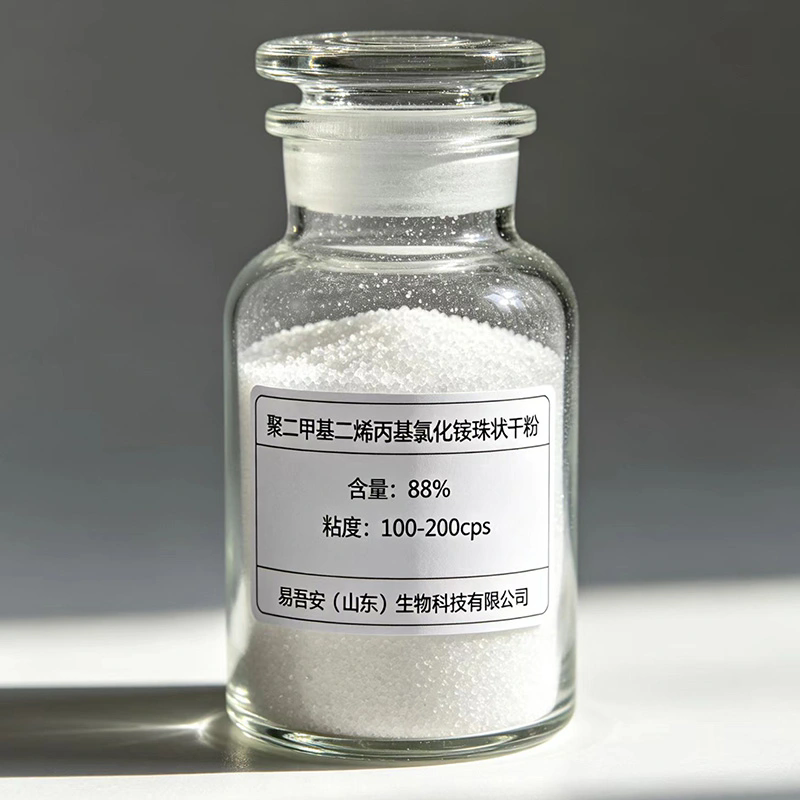
Water‑treatment, papermaking and textile finishing processes frequently rely on cationic polyelectrolyte materials to modify colloidal particle behaviours within aqueous media, and PolyDADMAC Powder delivers permanent positive charge groups along macromolecular backbones for destabilization and adsorption purposes. This article covers polymerization fundamentals, molecular‑structure related performance traits, dissolution workflows, critical application parameters, compatibility constraints, storage protocols and common operational pitfalls. Process engineers and formulation technicians can gain systematic technical knowledge for laboratory evaluation and full‑scale industrial deployment. All content focuses on chemical characteristics and practical process guidance without commercial‑oriented performance metrics. Environmental adaptation boundaries and typical troubleshooting guidance are provided to support stable operation of colloidal treatment workflows across multiple industrial sectors.
Table of Contents — Click to jump to each section
- 1. Core Polymer Chemistry and Electrostatic Interaction Mechanisms
- 2. Key Molecular‑Structure Factors That Determine Practical Performance
- 3. Standard Dissolution Procedures and Solution Preparation Guidelines
- 4. Major Industrial Application Scenarios and Functional Expectations
- 5. Working‑Condition Variables That Influence Field Treatment Outcomes
- 6. Proper Storage, Handling and Cross‑Additive Compatibility Rules
- 7. Frequently Asked Technical Questions
- 8. Access Additional Technical Documentation and Expert Guidance
1. Core Polymer Chemistry and Electrostatic Interaction Mechanisms
Macromolecular charge origin and colloidal destabilization
Most suspended fine particles in natural and industrial water carry net negative surface charge. Identical surface charges create electrostatic repulsion, keeping tiny particles stably dispersed instead of aggregating into separable flocs. Cationic polyelectrolyte macromolecules neutralize these surface charges and provide bridging sites for particle assembly. This fundamental principle defines how this polymer class works within aqueous‑phase treatment workflows.
Quaternary ammonium functional groups built into the polymer chain deliver non‑pH‑dependent positive charge. Unlike amine‑based cationic polymers that rely on protonation to obtain charge, quaternary ammonium structures retain ionic characteristics over broad pH ranges. This trait expands usable operational windows for many real‑world process water streams with fluctuating alkalinity or acidity.
Two primary effects take place when polymer chains interact with suspended colloids: charge neutralization and polymer bridging. Charge neutralization lowers surface electrostatic repulsion so particles can collide and stick together. Polymer bridging occurs when single macromolecular segments adsorb onto multiple separate particle surfaces, linking individual fine particles into larger aggregated floc structures.
Floc morphology directly affects subsequent solid‑liquid separation efficiency. Compact, dense flocs settle rapidly under gravity; loose and fragile flocs may break apart under pump shear or pipeline turbulence. Molecular weight and charge density jointly shape final floc physical properties, so these two parameters deserve close attention during material grade screening work.
- Permanent cationic charge: functional groups maintain ionic status independent of surrounding aqueous‑phase pH value
- Dual working modes: achieves colloidal destabilization via charge neutralization plus macromolecular bridging effects
- Water‑soluble macromolecule: dissolves into aqueous phase without requiring organic co‑solvent additives
- Chain‑conformation shift: ionic strength of surrounding solution changes polymer stretching or coiling behaviour
Solution ionic strength brings important conformational impacts. Elevated dissolved‑salt concentration compresses electrical double layers surrounding charged polymer segments. Polymer chains contract into more compact coil shapes, reducing effective contact area available for particle adsorption. Lab test results produced using low‑salt pure water may deviate from performance observed inside high‑salinity industrial process water.
PolyDADMAC Powder depends on well‑balanced charge density and molecular‑weight parameters to deliver reliable colloidal treatment. Understanding these underlying chemical mechanisms helps technical personnel interpret lab test data and adjust operational parameters for on‑site process water conditions.
2. Key Molecular‑Structure Factors That Determine Practical Performance
Variation in synthetic polymerization conditions generates powder grades with distinct molecular characteristics. Adjustments in monomer feed ratio, initiator dosage, reaction temperature and reaction time modify average molecular weight, molecular‑weight distribution and charge‑density indexes. Each structural parameter creates measurable differences during real‑world treatment workflows.
Critical structural‑performance relationships
- Average molecular weight: influences bridging capacity and resulting floc size magnitude
- Charge density: quantity of cationic functional groups distributed along each polymer macromolecule
- Molecular‑weight distribution: width range of individual polymer chain lengths within finished powder product
- Residual monomer content: unreacted starting monomer remaining after polymerization and purification stages
| Structural Parameter | Main Functional Influence | Practical Process Observation | Important Remarks |
|---|---|---|---|
| Low‑to‑Medium Molecular Weight | Dominant charge‑neutralization effect | Produces relatively compact small‑sized flocs | Well‑suited for high‑colloid‑content water requiring strong charge suppression |
| High Molecular Weight | Enhanced macromolecular bridging capacity | Generates larger floc structures, higher settling velocity | More vulnerable to mechanical shear‑induced chain fracture |
| High Charge Density | Strong electrostatic attraction toward anionic colloids | Fast initial destabilization reaction rate | Over‑dosage may trigger restabilization of suspended particles |
| Moderate Charge Density | Balanced neutralization and bridging performance | Broad usable dosage interval window | Suitable for variable‑quality complex process‑water streams |
Over‑dosage represents a frequently encountered phenomenon tied directly to charge‑density characteristics. Adding excessive cationic polymer reverses particle surface charge from negative toward positive. Once particles regain identical positive surface charge, electrostatic repulsion reappears and suspended particles become restabilized, which significantly worsens solid‑liquid separation outcomes. Operators must identify proper effective dosage range through gradient jar‑test trials.
Molecular‑weight distribution also shapes field behaviours. Products with broad distribution contain both ultra‑long and relatively short polymer chains. Narrow‑distribution grades deliver more consistent performance response to dosage changes. Material technical specification sheets should list these indexes to support rational grade‑selection work for process projects.
PolyDADMAC Powder grades cannot be evaluated by single‑index comparison. Both molecular‑weight and charge‑density attributes need simultaneous consideration to match specific aqueous‑system treatment requirements.
3. Standard Dissolution Procedures and Solution Preparation Guidelines
Dry powder cannot be directly fed into process water streams. Complete, uniform dissolution represents a prerequisite for expected functional performance. Improper dissolving techniques produce undissolved micro‑gel particles or aggregated polymer lumps. These incompletely dissolved fractions fail to participate in colloidal interactions and reduce effective utilization efficiency of polymer material.
Step‑wise dissolution workflow
1. Prepare clean dissolution tank filled with room‑temperature pure water. Avoid using high‑salinity raw process water for initial dissolving operations, because high ionic strength slows polymer chain hydration and dissolution progress.
2. Activate moderate‑speed stirring equipment. Vigorous high‑speed agitation must be avoided, as intense mechanical shear fractures long macromolecular chains and permanently degrades polymer functional performance.
3. Spread dry powder slowly and evenly across liquid surface. Rapid dumping of large powder quantities creates sticky hydrated outer skins that trap inner dry powder and form persistent insoluble agglomerated lumps.
4. Maintain gentle stirring for sufficient hydration duration. Required dissolving time correlates with molecular‑weight grade. Higher‑molecular‑weight material generally demands longer full‑hydration periods.
5. After full dissolution completes, prepared stock solution can be further diluted before dosing toward target process pipelines. Avoid long‑term storage of diluted working solution.
Key operational pitfalls to avoid
Excessive stirring shear force creates irreversible macromolecular degradation. Once polymer chains are mechanically broken, original bridging capacity cannot be restored through any subsequent processing steps. Dissolution‑tank agitator configuration should prioritize homogeneous liquid mixing instead of pursuing high peripheral linear velocity.
Prepared aqueous stock solution possesses limited usable shelf life. Even under suitable ambient conditions, gradual slow hydrolytic degradation reduces average molecular weight over elapsed time. Preparing working‑strength solution right before usage yields better treatment results than making large‑volume stock for multi‑day consumption.
Dissolved solution filtration is worthy of consideration for critical process loops. Tiny undissolved gel fragments may accumulate inside dosing pipelines, valves and spray nozzles, eventually causing partial or complete flow‑path blockage. Simple in‑line filter assemblies protect downstream dosing hardware from blockage risks.
PolyDADMAC Powder delivers its designed treatment potential only after full, low‑shear hydration. Standardizing dissolving workflows eliminates many avoidable on‑site performance‑degradation causes.
4. Major Industrial Application Scenarios and Functional Expectations
Cationic water‑soluble polymer powder finds deployment across diverse industrial workflows where surface‑charge modification or particle aggregation is required. Different sectors set distinct functional priorities: some focus mainly on charge neutralization, while others emphasize floc‑formation capability or surface adsorption modification effects.
Representative industrial deployment cases
- Potable and municipal wastewater treatment: assist removal of organic colloids, colour‑causing substances and fine suspended particulate matter inside water streams
- Papermaking production workflows: applied for retention‑aid and drainage‑improvement purposes, adsorbing fine fibre and filler particles onto pulp fibre surfaces
- Textile printing‑and‑dyeing wastewater: neutralize anionic dye colloidal fragments to promote aggregate formation for subsequent solid‑liquid separation units
- Mineral‑processing water circuits: handle fine mineral tailing particles to accelerate sedimentation inside clarification and thickener equipment
- Sludge‑dewatering pretreatment: condition sludge surfaces to improve filter‑press or centrifuge solid‑liquid separation efficiency
Each application scenario brings unique water‑matrix backgrounds. Papermaking process streams contain abundant cellulose‑fibre fragments and mineral‑filler particles. Dye‑plant wastewater carries complex dissolved chromophore molecules alongside variable alkalinity. Mineral‑tailing water often holds high total dissolved‑salt levels. Universal fixed‑dosage values cannot suit all these varied water‑matrix environments.
Dosage‑determination thinking
Laboratory jar‑test trials act as essential preliminary evaluation method. Gradient dosage series simulate different polymer addition levels and record floc‑forming speed, floc physical appearance, supernatant clarity and sediment compaction status. Observations from jar‑test experiments offer reference ranges for subsequent full‑scale process‑system commissioning. Real‑world pipeline turbulence and mixing intensity still demand fine‑tuning after transferring to production‑scale hardware.
Mixing condition represents one easily‑overlooked variable. Sufficient micro‑mixing must happen immediately after polymer dosing to achieve uniform polymer‑colloid contact. Insufficient local mixing creates zones of over‑dosage and zones of under‑dosage coexisting within same water stream, which lowers overall treatment efficiency despite correct average calculated addition quantity.
5. Working‑Condition Variables That Influence Field Treatment Outcomes
Even when using identical powder grade and fixed dosage value, shifting process‑water parameters can produce large differences in final treatment effect. Process technicians need to monitor these changing variables and adjust operational parameters correspondingly instead of keeping static dosing setpoints permanently.
Primary influential environmental variables
- pH value of incoming water: although polymer charge stays stable, pH modifies surface‑charge property of suspended colloidal particles
- Total dissolved‑salt concentration: high ionic strength compresses polymer chain dimension and changes adsorption behaviours
- Suspended‑solid loading: fluctuation of incoming particle concentration directly shifts required effective polymer dosage
- Turbulence and shear intensity: excessive mechanical agitation breaks formed flocs and fractures long polymer macromolecules
pH variation does not alter intrinsic quaternary‑ammonium cationic charge carried by polymer chains, yet it changes surface‑charge magnitude of target colloidal particles. Under low‑pH circumstances, many mineral‑particle surfaces reduce their negative‑charge density. Under high‑alkaline environments, negative surface charge of organic colloids may become more significant. These shifts modify quantity of polymer needed to reach optimal charge‑neutralization status.
Shear‑force management matters throughout the whole treatment sequence. After polymer addition completes, mixing intensity should provide uniform micro‑distribution, yet avoid sustained violent stirring. Once well‑formed floc structures are generated, they become mechanically fragile. Passing high‑shear pumps will shatter large flocs into tiny fragments which cannot re‑aggregate, reducing settlement‑unit performance.
Water‑quality fluctuation response strategy
Real‑world industrial water‑quality conditions rarely remain perfectly stable. Raw‑water inflow composition shifts according to upstream production‑work‑schedule changes. Setting fixed manual dosing cannot adapt to these variations. Building simple jar‑test verification cycles into daily‑shift operational routines helps operators adjust dosing levels in response to incoming‑water‑quality changes.
6. Proper Storage, Handling and Cross‑Additive Compatibility Rules
Correct raw‑material preservation and chemical‑compatibility assessment protect material intrinsic performance and prevent unexpected adverse reactions inside mixed‑formulation systems. Many field incidents originate from incompatible additive mixing or improper long‑term powder‑storage conditions.
Dry‑powder storage specifications
Dry powder product should be kept inside original sealed packaging, placed within cool, dry and well‑ventilated warehouse environments. High‑humidity ambient atmosphere will make powder absorb atmospheric moisture, triggering partial caking. Caked material cannot be restored back to original free‑flowing powder state. Sealed packages need to remain closed whenever material is not being dispensed. Avoid direct exposure to intense sunlight or sustained high‑temperature storage surroundings.
- Isolate from anionic polyelectrolyte products: direct mixing generates insoluble polyelectrolyte complex precipitates
- Keep separate storage space: physically separate stock zones for cationic and anionic polymer raw‑material containers
- Prevent cross‑contamination: use dedicated dissolving tanks, transfer pumps and pipelines for cationic polymer processing
- Check packaging integrity: inspect incoming packages for moisture‑ingress‑related damage before warehouse receiving acceptance
Compatibility with anionic polymer substances deserves special emphasis. When cationic polymer solution mixes together with anionic polymer solution, positive‑charged macromolecules and negative‑charged macromolecules attract each other and precipitate out of aqueous phase. The generated flocculated complex deposits will foul tanks, pipelines and process‑equipment surfaces. Never prepare stock solutions of opposite‑charge polymers inside same tank without intermediate full cleaning procedures.
Personal handling safety should also receive attention. Dry fine powder may produce airborne dust during transferring operations. Reasonable ventilation and simple dust‑avoidance operating habits reduce dust‑inhalation risk for on‑site operators. Spilled powder should be collected and not flushed directly into process‑water pipelines without proper treatment assessment.
7. Frequently Asked Technical Questions
This phenomenon is particle restabilization caused by over‑dosage. Excess cationic polymer coats suspended particle surfaces and reverses overall surface charge from negative to positive. Mutual electrostatic repulsion reappears among particles, preventing aggregation and floc formation. Gradient jar‑test trials help identify narrow effective dosage window and avoid crossing this restabilization threshold.
No. Longer polymer macromolecular chains require longer hydration time to achieve full dissolution. High‑molecular‑weight powder needs extended gentle mixing duration. Forcing rapid dissolution by raising stirring speed will introduce destructive mechanical shear and break long polymer chains, permanently lowering bridging‑related functional performance.
The polymer itself retains its cationic charge across wide pH ranges. However, target colloidal‑particle surface‑charge status changes under extreme pH. Jar‑test assessment under actual process‑water pH is still necessary. Very extreme pH environments may bring auxiliary side‑effects such as accelerated polymer hydrolytic degradation for long‑time solution storage scenarios.
These gel fragments mainly stem from incomplete powder hydration during dissolution steps, or partial material hydrolysis after prolonged stock‑solution storage. Poor powder spreading technique creates outer‑hydrated lumps with dry powder trapped internally. Installing suitable in‑line filtration assemblies can intercept these gel fragments and protect downstream dosing equipment from blockage failure.
8. Access Additional Technical Documentation and Expert Guidance
Cationic polyelectrolyte application belongs to interdisciplinary technical territory combining polymer chemistry, colloid science and industrial water‑process engineering. Every real‑world project carries unique water‑quality characteristics, mixing‑hardware conditions and separation‑unit configurations. General theoretical resources cannot fully substitute condition‑specific laboratory evaluation work.
Material specification sheets, safety‑related documentation and technical application guides offer important reference information for formulation and process‑engineering teams. Carrying out comparative jar‑test screening before full‑scale deployment greatly reduces unexpected performance deviation risks during formal production‑system operation.
Ewooan accumulates practical experience in cationic polymer material research, grade‑performance evaluation and industrial‑process application consultation for aqueous‑colloid‑treatment‑related projects across multiple industry verticals.
Reach out to obtain targeted technical consultation for your polymer‑related process challenges.
contact us